

SDV Insider - August 21, 2026
Welcome back to SDV Insider.
For most of the past five years the software-defined vehicle conversation has been an argument about capability. Can the vehicle be updated, how deep into the stack does the update reach, whose architecture gets there first. That argument is now largely settled, and the stories that landed between August 13 and August 20 suggest what replaced it. Almost none of them are about what a system can do. Nearly all of them are about who agreed to let it operate.
Momenta, XHEART and BlackBerry’s QNX division put out a jointly certified autonomy stack. Nevada’s transportation regulator approved commercial robotaxi permits for three operators at once. California’s utilities commission cleared Waymo to charge for driverless rides across 18 counties. Volkswagen Group China launched an in-house driver assistance product through CARIAD’s local competence center. Different continents, different companies, one shape: in every case the technical work was already done and the news was that somebody said yes.
That’s a meaningfully different market from the one that existed two years ago. When capability was scarce, the winners were the teams that could build the thing. When capability is abundant and permission is scarce, the winners are the teams that can prove the thing: to a certification body, to a state regulator, to a type approval authority, to a customer’s legal department. Those are evidence problems rather than engineering problems, and they are won with instrumentation and traceability rather than with demos.
The signal this week: the binding constraint on software-defined vehicles has shifted from what the stack can do to who will authorize it, and the companies built to produce evidence are about to look very different from the companies built to produce features.
🚀 Top Story
Momenta, XHEART and QNX Ship a Pre-Certified Autonomy Stack Aimed at Export Markets
On August 19, Momenta, chip designer XHEART and BlackBerry’s QNX division announced a joint mass-production autonomous driving platform. Momenta contributes its full-stack autonomous driving algorithms, XHEART supplies its automotive-grade X7 system on chip, and QNX provides a safety operating system built on SDP 8.0. The three layers are sold as one integrated product, available to global mainstream automakers.
The technical composition is not the news. The certification is. The combined solution carries TÜV Rheinland ISO 26262 ASIL D certification, the highest functional safety grade, and the partners state it meets entry requirements for regulated markets including Europe under UN R171 on driver control assistance systems. Momenta senior vice president Sun Huan framed safety as the precondition for scaling physical AI internationally, positioning the package as something automakers can carry into export programs with less regulatory exposure. QNX described the arrangement as consolidating its position in autonomous driving foundational software.
Read that against where the Chinese autonomy sector was eighteen months ago and the change is stark. The domestic competition was fought on feature velocity, urban navigation coverage and price. This is a different pitch entirely, and it is aimed squarely outward: Europe and the Middle East have been tightening functional safety and cybersecurity requirements on advanced driver assistance, and the practical effect has been to make integration of foundational software, silicon and algorithms a prerequisite for mass production rather than an optimization. A stack that arrives with the paperwork already done removes the single most expensive item from an OEM’s international program plan.
Our Take: While this story looks like a supplier announcement, it actually represents the productization of compliance. For a decade the assumption in Western procurement was that Chinese autonomy software was fast, cheap and regulatorily untouchable outside China, so the risk calculus took care of itself. ASIL D from TÜV Rheinland plus a stated R171 path dismantles half that assumption in one release. The remaining barrier is data governance and ownership nexus rather than engineering quality, and that is a political variable rather than a technical one, which makes it considerably less predictable for anyone building a five-year sourcing strategy. The second implication matters more for the platform layer. When algorithms, silicon and the operating system are certified together, the certification boundary becomes the product boundary, and anything outside it has to prove itself separately. Update management, diagnostics, data collection and fleet operations all sit outside it, so whoever owns those layers must now demonstrate that adding them does not invalidate the certification underneath. That is an evidence burden rather than a feature list, and vendors who can produce campaign-level records of exactly what software ran on which vehicle and when will find it far easier to satisfy.
⚙️ Industry Pulse
Nevada Clears Up to 8,000 Robotaxis in One County Across Three Operators
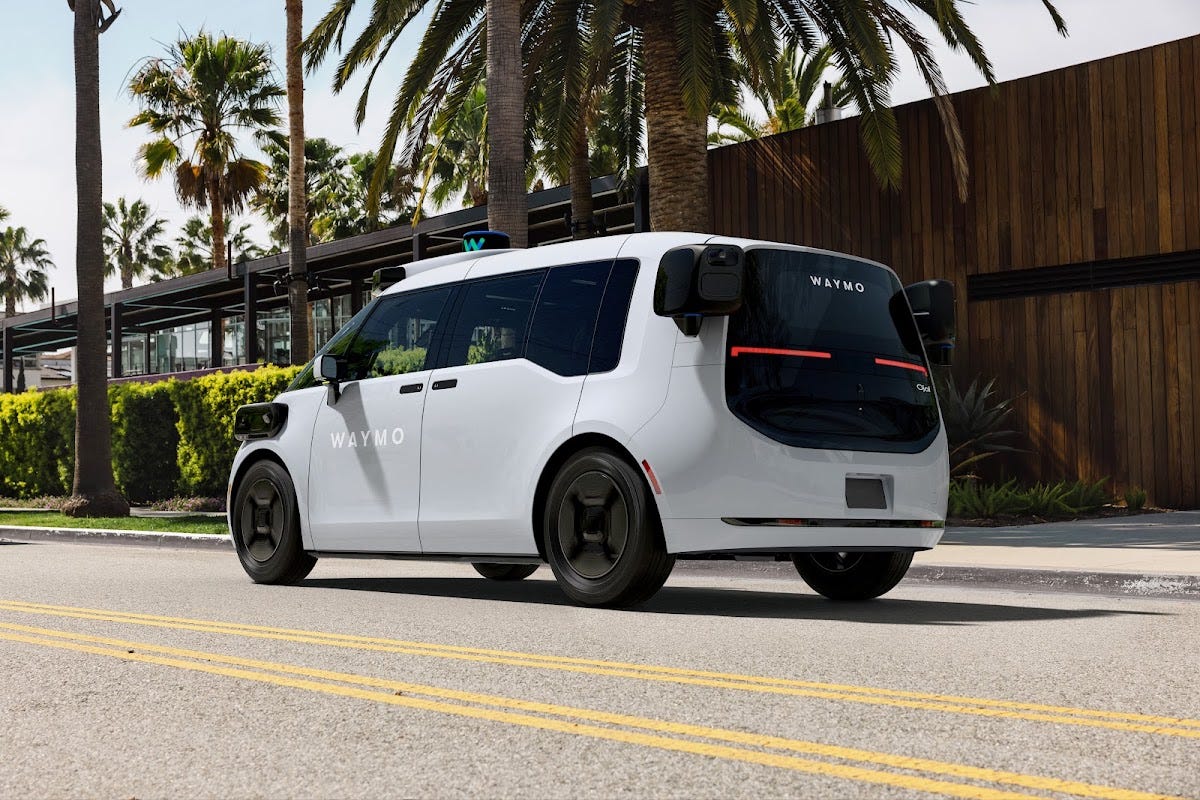
Waymo’s sixth-generation Driver on the all-electric Ojai. Waymo holds one of the three Nevada permits. Source: Waymo.
The Nevada Transportation Authority unanimously approved three permits on August 20 allowing Tesla, Uber and Waymo to run commercial robotaxi services in Clark County, home to Las Vegas. Together the permits cover up to 8,000 vehicles over the next twelve months: 5,000 for Tesla, 1,000 for Waymo and 1,000 for Uber, which will operate through partnerships with Hyundai subsidiary Motional and with Zoox. Zoox separately holds an autonomous vehicle network company permit for 100 vehicles. Whether any operator actually fields those numbers is a different question, and representatives from the Livery Operators Association and local taxi companies opposed the approvals as moving too fast. Even at half the authorized volume, Clark County becomes the densest robotaxi contest in the United States, and the first place where fleet operations software gets stress tested against genuine multi-operator scale rather than pilot scale.
Waymo Wins California Approval to Charge for Driverless Rides Across 18 Counties
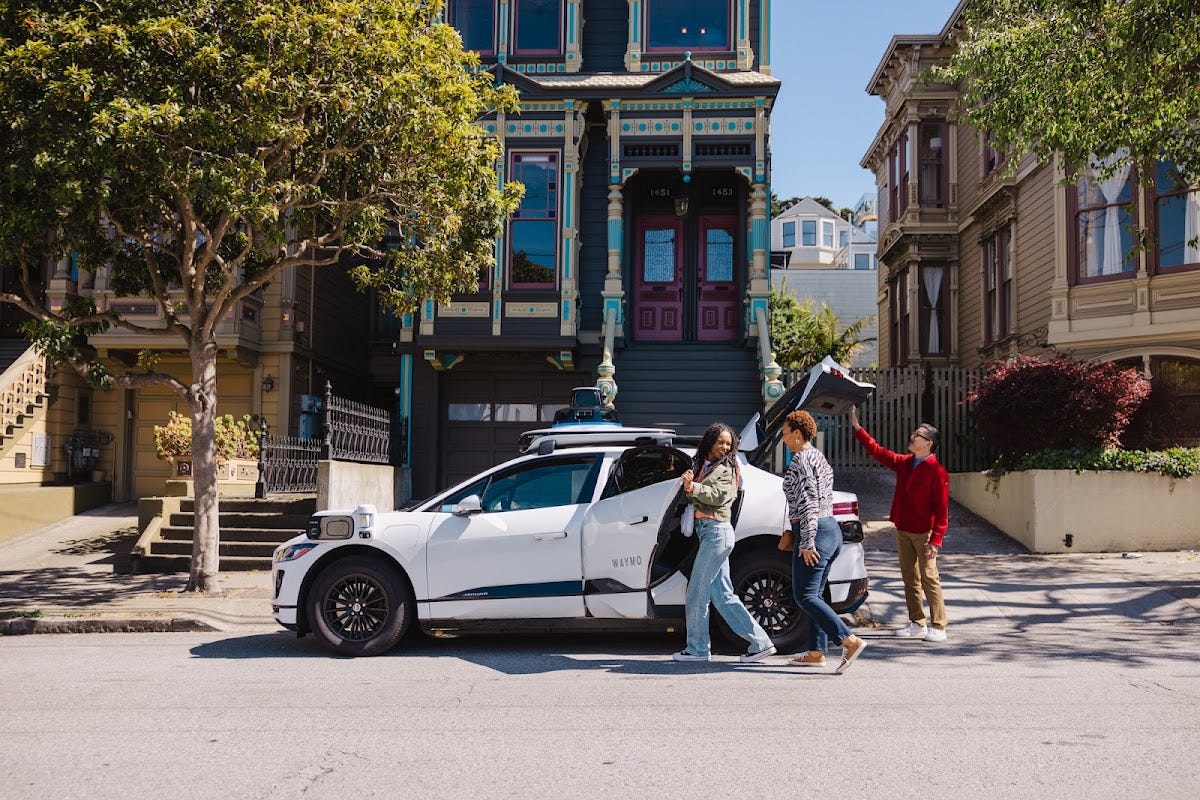
A Waymo vehicle serving riders in San Francisco, one of the 18 counties covered by the approval. Source: Waymo.
The California Public Utilities Commission approved Waymo’s updated Passenger Safety Plan on August 14, clearing the company to expand paid driverless service across the entire San Francisco Bay Area and Los Angeles and to open Sacramento and San Diego as new markets, spanning 18 counties from Sonoma to San Diego. Waymo said the rollout would be gradual and guided by its safety framework. The approval runs through Advice Letter No. 4, filed in January and suspended for further review, with a supplemental filing in May covering unaccompanied minors and rider procedures during service disruptions. The regulatory asymmetry is the detail worth holding: Waymo and Zoox file quarterly under autonomous vehicle permits with safety reporting and data transparency obligations, while Tesla operates its Bay Area service under a charter-party carrier permit, the same category a limousine company holds, which carries none of those requirements.
Volkswagen Group China Launches Driver Assistance It Developed Itself
CARIAD announced that Volkswagen Group China has launched its first in-house developed full-scenario driving assistance product through CARIZON, its intelligent driving competence center. The system, called HS8 or Hyper Sense 8, is a one-step end-to-end L2++ solution tuned specifically for the road conditions and traffic patterns Chinese drivers encounter. For a group whose software division became the industry’s cautionary tale, an in-region team shipping a production ADAS stack is a genuine milestone. It also confirms the structural answer Western OEMs have converged on for China: not buying the local stack, not exporting the German one, but standing up a local software organization with its own release authority. The open question is what happens at the seams, because a vehicle running regionally developed driver assistance on a globally developed platform has to reconcile two update pipelines, two validation regimes and two sets of type approval evidence.
Nobody Knows How Long a Software-Defined Vehicle Lasts
CNBC put a question to the industry on August 15 that it has been avoiding: what happens to a software-defined vehicle when it gets old. The average vehicle in the United States is now 12.8 years old according to Mobility Global, and Americans are keeping cars longer than ever, while the support cycles that govern phones and laptops run a fraction of that. Analysts quoted in the piece worry that heavily software-dependent vehicles will age like consumer electronics rather than like cars, with proprietary platforms requiring specialized skills, tools and data access to service. Right to repair legislation is spreading through US states, which turns an engineering question into a legal one. This is the unglamorous end of the in-life data argument and it is where the next decade of warranty, residual value and regulatory exposure actually lives. An OEM that cannot state how long it will keep updating a vehicle is making an implicit promise it has not priced.
SiEngine Puts a 7nm Automotive AI Accelerator Into Full Mass Production
SiEngine announced that its self-developed automotive-grade 7nm AI accelerator, the Tiangong 100 or NNA100, has entered full mass production with bulk shipments now going to OEMs and Tier 1 partners. Reported in the same window: BYD’s assisted driving fleet has passed 3.52 million vehicles. Those two figures belong together. Domestic silicon reaching volume production and a single domestic OEM operating a 3.5 million vehicle assisted driving fleet describe a supply chain that no longer depends on imported compute for mainstream driver assistance, and a data collection footprint large enough to train against. The compute question in China has quietly stopped being about access and started being about yield and cost.
💼 Company Moves & Partnerships
UISEE and ComfortDelGro Bus Sign an Autonomous Bus Deployment Agreement
UISEE and Singapore-based ComfortDelGro Bus signed a memorandum of understanding covering autonomous bus technology validation, commercial deployment and ecosystem integration, with the stated aim of scalable and replicable operations. Public transit is the most demanding autonomy environment on the operational side even though it is the least demanding on the perception side, because fixed routes are easy and service level agreements, uptime obligations and depot logistics are not. Memoranda of understanding in this segment convert to revenue at a poor rate, so treat it as an intent signal rather than a deployment.
Changan and Honor Open a Joint Innovation Laboratory
Changan Automobile and smartphone maker Honor launched a Joint Innovation Open Laboratory, upgrading a partnership that dates to a joint development team formed in 2023. Changan is the first automaker to receive Honor’s joint certification authorization, using its Tianshu Intelligent Test Center, and the two have built a shared development, testing and certification chain rather than adapting features one at a time. The all-new Deepal S05 is first to carry Honor Smart Connect 3.0, and the technology now ships across 21 Changan models. Changan signed a broad AI, computing and digital infrastructure framework with Huawei in Shenzhen on August 11, so a second consumer electronics tie deepening inside a fortnight tells you how Chinese OEMs are hedging: not one alliance but a portfolio, with the cockpit as the contested surface.
📊 Market & Reports
A New Forecast Puts Automotive Cybersecurity at 18.86 Billion Dollars by 2033
MarketsandMarkets published a forecast on August 17 sizing the global automotive cybersecurity market at 6.88 billion dollars in 2026 growing to 18.86 billion by 2033, a compound rate of 15.5 percent, with software named as the fastest growing segment by offering. The reasoning behind the number is more useful than the number. The analysts attribute growth to architectural consolidation: as functions collapse into domain and zonal controllers, critical software and compute concentrate, and the blast radius of any single compromise grows accordingly. They also flag that providers are increasingly shipping AI-driven threat monitoring alongside secure over-the-air frameworks, treating update integrity and anomaly detection as one product rather than two. Apply the usual discount to any vendor-adjacent market sizing, since the boundary between automotive cybersecurity and general product security is drawn differently by every house that publishes one. The directional claim is harder to argue with, and it lines up with the September 11 EU Cyber Resilience Act reporting deadline now three weeks away.
👋 That’s a Wrap
Two things to watch. Honda and Nissan were targeting the end of August for the formal agreement on their shared vehicle operating system, and with roughly a week left that document either lands or slips, so we should know by the next issue whether it names a governance model or merely an intention. And the EU Cyber Resilience Act reporting obligations begin on September 11, with 24-hour early warning and 72-hour full notification windows for actively exploited vulnerabilities, reported through ENISA’s Single Reporting Platform. Note the carve-out that keeps catching people out: vehicles type approved under existing automotive frameworks sit outside the CRA, but the connected products around them, including diagnostics tools, charging equipment, aftermarket telematics and backend platforms, generally do not. Working out which side of that line each of your products falls on is a three-week job that should have started in June.
- The SDV Insider Crew 🚗💨