

SDV Insider - May 22, 2026
Welcome back to SDV Insider.
Last week, the foundation layer of the SDV stack - operating systems, embedded compute - was where the action was. This week, the action moved from the stack itself to the supply chain underneath it. The US House Transportation & Infrastructure Committee proposed writing Chinese LiDAR out of federally-funded infrastructure days before a German OEM signed China’s market leader as its L3 supplier.
Around that collision, the silicon and networking IP layer industrialized in the same news cycle: NXP and Quanta locked in a zonal SDV reference platform, Li Auto wired Arteris IP into its in-house autonomous SoC, and aiMotive shipped the first ISO 26262 ASIL-B-certified automotive NPU IP. Xpeng mass-produced its first vision-only L4 Robotaxi from a fully in-house silicon-to-vehicle stack. And Volvo and Google demonstrated Gemini reading the world through the EX60’s exterior cameras at Google I/O - the first visible production architecture for in-vehicle foundation-model AI.
The signal this week: the SDV stack is being layered fast, but the supply chain and regulatory floor underneath it is shifting at the same time. The OEMs that win will be the ones who can wire the stack together AND defend the floor it sits on.
🚀 Top Story
LiDAR Geopolitics: BUILD America 250 Bans “Covered Foreign” LiDAR Days After Hesai Lands Mercedes’ L3 Programs
Two announcements landed within 24 hours of each other this week, and together they redraw the LiDAR supply chain map for the SDV stack.
The US House Transportation & Infrastructure Committee released the BUILD America 250 Act, a five-year, ~$580B surface transportation reauthorization. Buried in the bill’s national security provisions is a clause prohibiting the Department of Transportation and any DOT-funded recipient from procuring LiDAR produced by “covered foreign sources” - which, in practice, means Chinese suppliers. Committee markup was targeted for May 21. The bill’s path through the Senate is uncertain, but the signal it sends to federally-funded infrastructure programs (V2X corridors, smart-roadway pilots, federal AV test programs) is immediate: don’t budget Chinese LiDAR going forward.
Within 24 hours, Hesai confirmed in its Q1 2026 earnings that it had been selected as strategic LiDAR supplier for Mercedes-Benz programs enabling Level 3 autonomy in both Europe and China. The deal is supported by Hesai’s new Galileo manufacturing center in Thailand - a footprint detail that just became commercially meaningful. Hesai holds 43% global share in long-range ADAS LiDAR and 55% share inside China. So the same supplier that just locked in a foundational L3 program at a German OEM is the supplier US legislation is being engineered to exclude.
Our Take: OEMs with US program exposure have spent two years assuming their perception supply chains were resilient. This week put a clock on that assumption. Three things to watch. First, whether Mercedes can fulfill US deliveries of L3-enabled vehicles without exposure to federally-funded program restrictions - the Thailand manufacturing footprint is the variable. Second, whether the BUILD America 250 LiDAR clause survives Senate negotiation; if it does, the precedent of country-of-origin restrictions on perception sensors will likely extend to other sensor categories. Third, whether US LiDAR suppliers (Innoviz, Luminar, Aeva, AEye) see a procurement bump from federal program operators trying to get ahead of the rule. For Tier 1s and OEM platform teams: this is the quarter to audit your perception sensor bill of materials by country of origin, manufacturing site, and parent-company ownership. The next geopolitical shock will hit sensors no one was tracking.
⚙️ Industry Pulse
Xpeng’s First Mass-Produced Robotaxi Rolls Off the Line - Vision-Only, Full-Stack, 3,000 TOPS
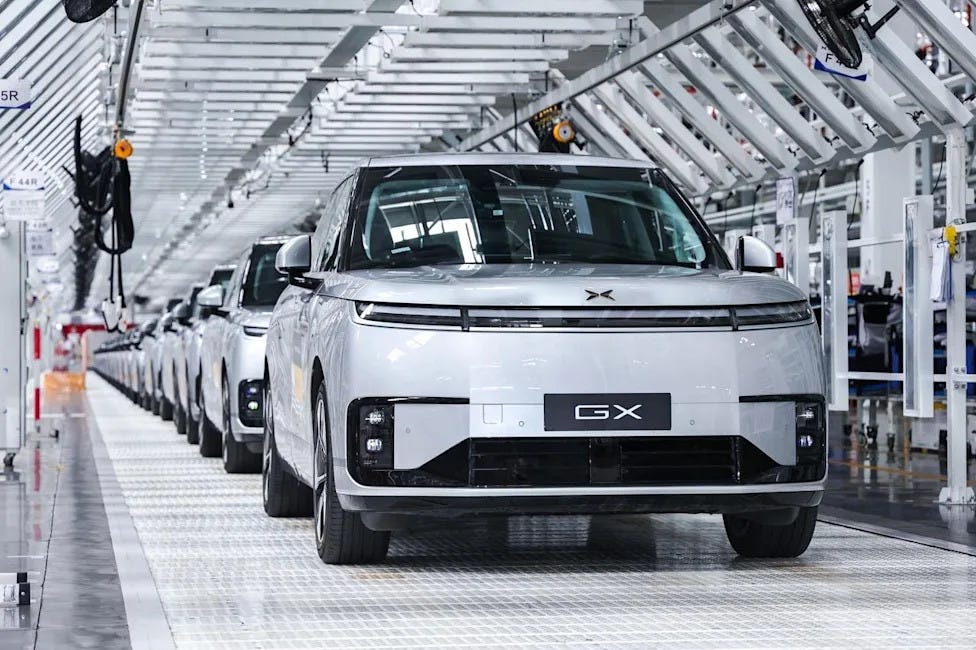
On May 18, Xpeng announced the first mass-produced unit of its Robotaxi rolled off the line in Guangzhou - the first time a Chinese automaker has hit mass production on a Robotaxi developed entirely in-house. The vehicle sits on the Xpeng GX platform, runs Xpeng’s VLA 2.0 end-to-end large model, and operates without LiDAR or HD maps. Compute is delivered by four Xpeng-designed Turing AI chips for a combined 3,000 TOPS on board. Pilot operations are scheduled for the second half of 2026, with fully driverless operations (no on-site safety officer) targeted for early 2027. The vertical integration here - silicon, model, vehicle, manufacturing, and operations - is the kind of stack depth Western OEMs have spent five years trying to assemble through partnerships.
NXP and Quanta Lock in a Deterministic Zonal Networking Reference for SDVs
NXP and Taiwan’s Quanta announced a collaboration on May 14 to deliver a zonal networking platform purpose-built for next-generation vehicle architectures, anchored on NXP’s S32 automotive processors and the TrustMotion MotionWise® middleware. The technical stack - S32 zonal controllers, SJA1110 TSN switches, CAN/LIN connectivity, scalable multi-PMIC power - targets the deterministic real-time timing problem that’s been the biggest late-stage integration risk for OEMs moving from domain to zonal E/E architecture. The platform is available now with demonstrations underway on Quanta development hardware. This is the kind of joint silicon-plus-systems-integrator reference that lets OEMs skip a year of bring-up.
Volvo and Google Demo Gemini Reading the World Through the EX60’s Exterior Cameras
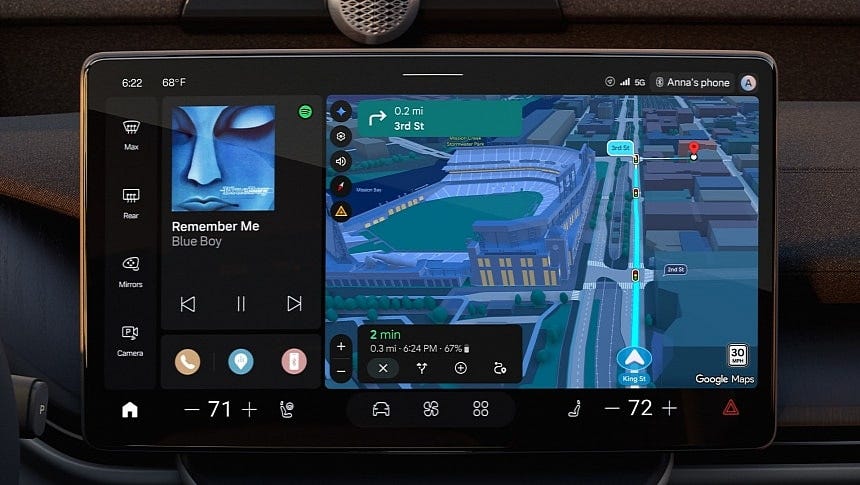
At Google I/O on May 19, Volvo and Google showed Gemini interpreting the EX60’s exterior camera feed in real time - reading parking signs, identifying landmarks, translating foreign-language street signs, and answering driver questions about the surroundings. The compute is local: the EX60’s onboard NPU and Qualcomm Snapdragon SoC handle the multi-modal inference, with OTA updates as the delivery channel. Privacy posture: opt-in, faces blurred during analysis. The feature itself is early-stage, but the architecture being demonstrated - large foundation model + automotive-grade SoC + structured spatial-context input from the vehicle’s existing sensor suite - is the template a lot of OEMs will copy in 2026–2027.
Tesla’s FSD Lands in Lithuania 🇱🇹 and Picks Up a European Regulatory Shortcut
Tesla confirmed on May 20 that Full Self-Driving (Supervised) is rolling out to Lithuanian owners over the air, making Lithuania the second European country to permit FSD. The mechanism deserves attention: Lithuania’s Transport Safety Administration didn’t run an independent review - it recognized the provisional type approval Tesla received from the Dutch RDW on April 10 and applied it. The Greek transport ministry said Wednesday it has a similar bill in motion. Meanwhile, emails obtained by Reuters reveal that Sweden, Finland, Denmark, and Norway are openly skeptical, citing FSD’s tendency to exceed speed limits and its performance on icy roads. Type-approval cross-recognition will accelerate FSD’s European footprint where regulators are willing to defer; the Nordics aren’t going to defer. The European AV regulatory map is going to fragment, not consolidate.
💼 Company Moves & Partnerships
Mitsubishi Motors Signs Software MoU With FPT Japan - JV on the Table
Mitsubishi Motors signed an MoU with FPT Japan Holdings - the Japanese arm of Vietnam’s FPT Corporation - on May 14 to study collaboration across software development, AI, and digital services, with a potential joint venture explicitly named as a possible outcome. CEO Takao Kato framed the partnership as a way to combine Mitsubishi’s mobility expertise with FPT’s IT talent base. The interesting angle: this is a smaller-OEM strategy. Mitsubishi can’t build a Cariad-sized in-house software org, so it’s effectively outsourcing the SDV capability buildout to a global IT services partner with Vietnamese engineering scale. Expect more Tier-2 OEMs to follow this shape rather than the German “stand up your own software subsidiary” model that’s now visibly under stress.
Li Auto Wires Arteris IP Into Its In-House Autonomous SoC (2,560 TOPS, L9 Livis)
Arteris announced on May 20 that Li Auto adopted its FlexNoC 5 interconnect IP and Magillem SoC integration automation for the autonomous-driving SoC powering the all-new L9 Livis SUV. The SoC delivers 2,560 TOPS of AI compute and is engineered to meet automotive functional safety requirements. Li Auto launched the L9 on May 15 with deliveries starting May 17. Two read-throughs: first, the in-house custom SoC trend at Chinese NEV makers (Xpeng’s Turing, NIO’s NX9031, now Li Auto’s) is solidifying - these companies are increasingly looking like Tesla on the silicon question. Second, NoC interconnect IP is becoming the unglamorous-but-critical layer that lets OEMs scale custom AI silicon without re-architecting around each generation.
aiMotive Launches aiWare5 - The First ISO 26262 ASIL-B-Certified Automotive NPU IP
aiMotive opened general licensing of aiWare5 on May 14 - billed as the world’s first ISO 26262 ASIL-B-certified automotive NPU IP, with native support for LLMs, Vision Transformers, and state-space models, plus dynamic FP8 scaling and a GPU-optimized emulator that runs bit-accurate software development pre-silicon. Available for integration into automotive SoCs, dedicated AI coprocessors, or chiplets. The ASIL-B certification is the part to underline: most automotive NPU IP has been claiming functional safety readiness; aiMotive just shipped the documentation to back it. For Tier 1s and OEM SoC teams trying to consolidate ADAS and infotainment AI workloads onto a single safety-compliant accelerator, this is a procurement-ready datapoint.
📅 Upcoming Events
Autonomous Vehicle Tech Expo Europe - Stuttgart
June 23–25, 2026. Four conference tracks: Software/AI/SDV Architecture, Safe Autonomous Deployment, Simulation & Virtual Validation, and Standards & Regulation. Vector Informatik and Solectrix will premiere their joint camera-data replay solution for ADAS/AD validation at the co-located Automotive Testing Expo running the same week. A natural follow-on to last week’s Automotive Software Strategies in Munich and this week’s European AI & SDV Summit - the Stuttgart corridor is where the European SDV regulatory and architecture conversation is converging.
👋 That’s a Wrap
This week’s signal:
LiDAR is the first SDV sensor whose supply chain just became a US national security issue at the legislative level, and a German OEM signed a Chinese supplier within the same news cycle. Every OEM with US program exposure should be auditing country-of-origin on every perception sensor this quarter.
The SDV silicon, networking, and IP layer industrialized in a single week - NXP/Quanta zonal reference, Li Auto+Arteris in-house SoC, aiMotive’s first ASIL-B-certified NPU IP. Stack depth is no longer about whether the parts exist; it’s about who’s wiring them together fastest.
In-vehicle foundation-model AI just became visible in production hardware (Volvo + Gemini on the EX60). The architecture template - local NPU + cloud foundation model + structured spatial context from the vehicle’s sensor suite - will be copied across most premium OEMs by 2027.
Chinese OEMs continue to pull ahead on vertical integration. Xpeng mass-produced an L4 Robotaxi via fully in-house silicon, model, and manufacturing - the kind of stack depth Western OEMs have spent five years trying to assemble through partnerships.
Last week the foundation layer was poured. This week the supply chain floor underneath it cracked, the silicon-to-vehicle stack industrialized, and one OEM showed everyone what production in-vehicle AI actually looks like. The SDV winners of the late 2020s will be defined by how they wire the stack AND defend its floor.
- The SDV Insider Crew 🚗💨