

SDV Insider - April 3, 2026
Software may be global-but so is the calendar.
For those marking the Easter weekend-and for everyone else enjoying the early spring reset-this week’s developments offer a clear signal: the software-defined vehicle transition is entering a more structured, platform-driven phase.
We’re seeing a clear pattern emerge: platform standardization is accelerating. Big Tech is pushing deeper into the vehicle stack, OEM-backed architectures are proving themselves in real-world conditions, and commercial vehicle players are quietly unifying around shared operating systems.
At the same time, suppliers and regulators are racing to keep up-with centralized E/E architectures and cybersecurity frameworks moving from roadmap to requirement.

🚀 Top Story
Google Pushes Android Automotive Into the Core Vehicle Stack
Google is taking a decisive step toward becoming a foundational layer of the software-defined vehicle.
The company announced it will open-source its Android Automotive OS (AAOS) SDV platform, extending beyond infotainment into broader vehicle systems. Built in collaboration with partners like Renault and Qualcomm, the initiative aims to standardize large portions of the vehicle software stack via AOSP-bringing modularity, reuse, and faster development cycles to increasingly complex SDV architectures.
The move positions AAOS as a potential common software substrate across OEMs, enabling centralized software management, broader OTA coverage, and reduced fragmentation across vehicle programs.
Insider Take:
This is Google’s strongest bid yet to own the horizontal layer of the SDV stack. By stopping short of safety-critical systems, they lower regulatory friction-but still capture enormous surface area across the vehicle.
For OEMs, the tradeoff sharpens:
Gain: faster development, shared tooling, ecosystem leverage
Risk: platform dependency, data control, differentiation squeeze
If widely adopted, AAOS could do to automotive what Android did to mobile-standardize the base, and shift competition up the stack.
⚙️ Industry Pulse
VW–Rivian JV Hits Milestone, Unlocks Another $1B
Rivian secured another $1B tranche from Volkswagen after their joint venture (RV Tech) successfully completed winter testing across Sweden and Arizona. The validation covered zonal architecture performance, OTA reliability, and system durability under extreme conditions.
This brings Volkswagen’s total committed investment to $3B+, reinforcing that capital is now tied directly to SDV platform execution milestones.
Traton and Applied Intuition Launch “One OS” for Trucks
Traton Group and Applied Intuition unveiled Traton One OS, a unified SDV platform spanning Scania, MAN, International, and VW Truck & Bus. Built around centralized compute and high-performance ECUs, the platform targets full deployment by 2028, signaling that commercial vehicles may outpace passenger cars in true multi-brand software unification.
Schaeffler Doubles Down on Centralized E/E Architectures
Schaeffler introduced its Vehicle Control technology cluster, emphasizing centralized architectures that reduce ECU counts and accelerate development cycles across vehicle generations. This reinforces a broader industry shift: Zonal + centralized compute is no longer experimental-it’s now real baseline architecture.
AI Software Begins Entering Automotive Standards
A new proposed standard introduces AI software into automotive-grade compliance frameworks, targeting reliability and functional safety in ADAS and cockpit systems. This marks an important transition: AI is moving from experimental features → regulated system component.
💼 Company Moves & Partnerships
Hyundai + Geotab Bring Native Telematics to Fleets
Hyundai is integrating hardware-free telematics with Geotab, enabling cloud-based fleet insights without aftermarket devices. The shift: telematics is becoming native to the vehicle platform, not an add-on.
LEEO Launches Usage-Based Commercial Insurance
LEEO introduced a telematics-driven insurance model that ties premiums directly to real-time driving behavior. As SDVs generate richer data streams, insurance is evolving into a software-driven feedback loop, not just a financial product.
📊 Market & Reports
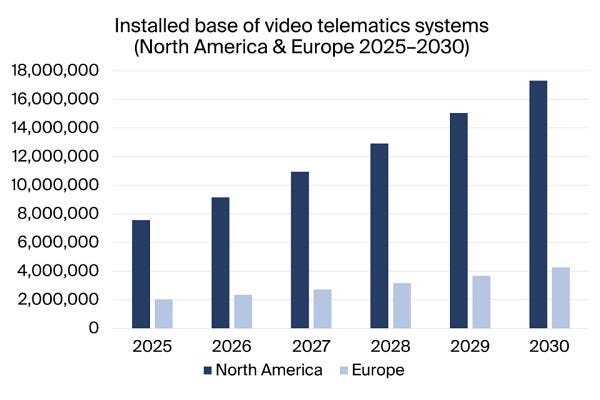
Video Telematics Set to Double by 2030
According to a new Berg Insight report, video telematics systems are projected to reach 22M units across the US and Europe, driven by camera integration, AI analytics, and platform convergence. North America is expected to lead-highlighting how data capture and interpretation are becoming core SDV capabilities.
👋 That’s a Wrap
This week’s signal is clear: the SDV stack is consolidating.
Big Tech is pushing horizontal platforms
OEMs are validating end-to-end architectures
Suppliers are aligning around centralized compute
Regulators are formalizing security and AI requirements
The next phase won’t be about proving SDVs are possible-it will be about who controls the platform layer, and who gets pushed up the stack.
See you next week.
- The SDV Insider Crew 🚗💨